
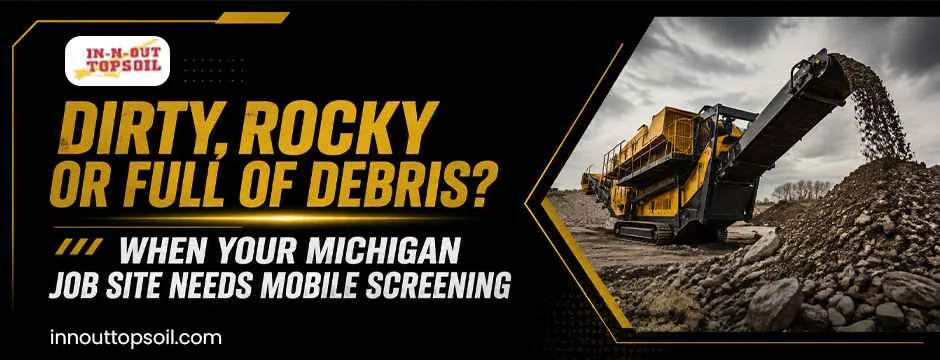
A pile of excavated soil can look harmless at first.
Then you take a closer look.
There are rocks mixed throughout it. Bits of concrete are buried in the pile. Roots, clumps of clay and other unwanted material have found their way into the mix. What looked like usable soil is suddenly a headache for the crew.
For Michigan contractors, landscapers, builders and property owners, this situation is more common than it may seem. Excavation, demolition, grading and landscaping projects can leave behind large quantities of mixed material. The obvious solution is often to load everything onto trucks and haul it away.
But that may not be the smartest option.
Mobile material screening in Michigan can help separate usable material from unwanted debris directly at or near the project site. Instead of automatically treating an entire pile as waste, screening gives you an opportunity to recover material that may still have value.
For projects where time, transportation costs and material quality matter, that difference can be significant.
What Is Mobile Material Screening?
Mobile material screening is the process of using portable screening equipment to sort bulk material according to size and composition.
Think about a pile of excavated soil. It may contain fine soil, stones, roots, construction debris and other unwanted materials. A screening machine processes that material and separates it into different sizes.
The result can be much more useful than the original mixed pile.
Depending on the project and material, screening may be used for:
- Topsoil
- Fill dirt
- Sand
- Gravel
- Aggregates
- Excavated soil
- Landscaping material
- Construction materials
- Demolition-related material
The biggest advantage is mobility. Rather than transporting every load somewhere else for processing, screening equipment can be brought closer to where the material is located.
That can simplify the entire material-handling process.
How Do You Know Your Job Site Needs Screening?
Not every dirt pile needs to be screened. Sometimes the material can be used as it is.
The challenge is knowing when a pile has crossed the line from usable material to material that needs processing.
Here are some situations worth considering.
1. Your Soil Is Full of Rocks
A little stone in soil may not be a major concern.
A lot of it is another story.
Large rocks and stones can make soil difficult to spread, grade and use for landscaping. They can also interfere with equipment and create an uneven finished surface.
If excavation has produced a large volume of rocky soil, screening may allow the finer material to be separated from larger pieces.
Instead of discarding the entire pile, you may be able to recover a substantial portion of usable material.
2. Construction Debris Is Mixed Into the Dirt
Renovation, demolition and construction projects can produce mixed material.
Concrete fragments, pieces of brick, wood, roots and other debris can become mixed with excavated soil. Using that material without processing may create problems later.
Screening provides a practical way to separate material by size and remove unwanted pieces from the usable portion.
For contractors, this can make site cleanup and material management considerably easier.
3. You Have More Soil Than You Expected
Excavation projects can produce an enormous amount of soil.
That material has to go somewhere.
Hauling every load away can become expensive, particularly when trucking, fuel, labour and disposal fees are added together.
Before arranging dozens of truckloads, it can make sense to determine whether some of the material can be screened and reused.
This is one of the reasons mobile material screening in Michigan can be attractive for larger projects. Processing material closer to the source may reduce unnecessary transportation and help contractors make better use of what they already have.
4. Your Topsoil Needs Cleaning Up
Good topsoil is valuable.
Unfortunately, excavated material does not always come out of the ground ready for landscaping. It can contain rocks, roots, clumps and other unwanted material.
Screening can help produce a more consistent material that is easier to work with.
For landscaping companies, developers and property owners, that can make a noticeable difference when preparing an area for planting, grading or turf installation.
5. You Are Paying Too Much to Move Dirt
This is perhaps the easiest warning sign to understand.
If your project involves repeatedly loading, transporting and disposing of material that could potentially be reused, you may be spending money unnecessarily.
Every truck trip adds to project logistics.
There is the loading time, transportation, fuel, driver time and destination costs. On a busy construction site, those costs can accumulate quickly.
Screening does not eliminate every hauling requirement, but it can help reduce the amount of material that needs to leave the site.
Why Screening On Site Can Make Sense
The phrase “on-site” is important.
When material is processed close to where it is generated, contractors have more control over what happens to it.
Instead of looking at a dirt pile simply as something that needs to be removed, the project team can assess whether it has another use.
That shift in thinking can help with both cost management and project efficiency.
For example, imagine a grading project that produces several hundred cubic yards of mixed soil. Some of that material contains rocks and debris, while another portion is relatively clean.
Hauling the entire quantity away means paying to transport material that may have been useful.
Screening can create an alternative.
The material can be processed, usable fractions can be separated and the project team can determine what should be reused, moved elsewhere on the property or removed.
That is a much more deliberate approach to material management.
The Value of On Site Screening Projects in Northville
Local projects can present their own logistical challenges.
For contractors handling on site screening projects in Northville, having access to mobile processing can be particularly useful when a project involves substantial quantities of excavated or mixed material.
Northville-area construction and landscaping projects may involve residential developments, commercial properties, grading work, excavation and site improvements.
In these situations, space, timing and transportation all matter.
A mobile screening solution can potentially reduce the need to move every load away for processing. It can also make it easier for crews to understand what material they actually have available.
For a contractor, that can mean fewer surprises as the project progresses.
Screening Can Help Keep Projects Moving
Construction schedules are rarely as simple as they look on paper.
One delayed activity can affect several others.
If excavated material is sitting where the next phase of work needs to happen, the crew has a problem. If usable material has to be transported away before grading can continue, the project becomes dependent on trucking availability.
Mobile screening can provide another option.
By processing material closer to the project, contractors may be able to keep useful material within the workflow instead of constantly moving it elsewhere.
That can be especially valuable on projects where timing is tight.
It Is Not Just About Dirt
When people hear “screening,” they often think only about soil.
The application can be much broader.
Depending on the equipment and project requirements, screening can be used to process different types of bulk material and separate larger unwanted pieces from smaller usable material.
This makes screening relevant to a range of industries and projects, including:
Landscaping: Preparing soil and other materials for installation work.
Excavation: Processing material generated during digging and site preparation.
Construction: Managing mixed materials generated during development and grading.
Demolition: Separating materials that may otherwise become part of a mixed waste stream.
Property development: Handling large quantities of excavated material efficiently.
The right screening approach depends on the material, project volume and intended end use. A professional assessment is important before deciding how material should be processed or reused.
Why Work With In N Out Topsoil in Michigan?
When you are dealing with a large material pile, the equipment is only part of the equation.
Experience matters too.
In N Out Topsoil in Michigan understands the practical side of handling soil and bulk materials for property owners, contractors and landscaping professionals.
The goal should not simply be to run material through a machine.
It should be to help you determine what you have, what can potentially be recovered and how the processed material can fit into the project.
That practical perspective can save time and prevent unnecessary material movement.
For customers, the benefit is straightforward: a cleaner, more manageable material stream and a more informed approach to what happens next.
What Should You Consider Before Screening?
Before arranging mobile screening, take a close look at the project.
Start with the material itself.
Is it mostly soil? Is there a high percentage of rock? Are there concrete fragments or other construction materials mixed throughout it?
Next, consider volume.
Screening a small pile may not make financial sense in every situation. A large excavation project with substantial material volume is a different calculation.
You should also consider the final use.
Will the screened material be used for grading? Landscaping? Fill? Another construction application?
The intended use can influence how the material should be processed.
Finally, think about site access.
Mobile equipment needs sufficient space for operation, material handling and safe movement. A professional screening provider can help determine whether the site is suitable.
Screening Can Be a Smarter Alternative to Automatic Disposal
There is an important difference between “waste” and “material that has not yet been sorted.”
That distinction can change how a project approaches excavation and site cleanup.
A pile containing rocks and debris may look unusable. But if a significant portion of that pile consists of recoverable soil or aggregate, throwing everything away may not be the most economical choice.
Screening creates an opportunity to find out.
For Michigan contractors and property owners, that can mean better material utilisation, fewer unnecessary trips and improved control over the project.
It also supports a more resource-conscious approach to construction and landscaping.
Is Mobile Screening Right for Your Project?
If your Michigan job site has large quantities of rocky soil, mixed dirt, topsoil, sand, gravel or debris, it is worth asking one simple question:
Does everything in this pile really need to be hauled away?
The answer may be no.
Mobile screening gives contractors and property owners another way to manage excavated and mixed material. Rather than automatically treating a large pile as a disposal problem, screening can help separate what is useful from what is not.
For projects where material volume is high and transportation costs are adding up, that can be a valuable difference.
Whether you are preparing a new development, completing excavation work, managing a landscaping project or cleaning up after construction, the right material-handling strategy can affect both the budget and the schedule.
That is where a professional screening service can make the process easier.
If your project is producing more dirt, rocks and debris than you know what to do with, talk to In N Out Topsoil about your material and project requirements. A closer look at what is actually in that pile could reveal that you have more usable material than you thought.
FAQs
1. What is mobile material screening in Michigan?
Mobile material screening involves bringing portable screening equipment to or near a project site to separate soil, rocks, debris and other bulk materials by size.
2. When should a Michigan construction site consider mobile screening?
It can be worth considering when a site has large quantities of rocky soil, mixed debris, excavated material or topsoil that needs to be processed before reuse.
3. Can mobile screening reduce the amount of material that needs to be hauled away?
Potentially, yes. Screening can separate usable material from unwanted debris, which may reduce the volume that needs to be transported or disposed of.
4. Are there on site screening projects in Northville?
Yes, mobile screening can be considered for suitable excavation, landscaping, construction and property development projects in the Northville area, subject to site conditions and material requirements.
5. Why choose In N Out Topsoil in Michigan for material screening?
A local provider can assess the material, project requirements and site conditions to help determine whether mobile screening is a practical solution for managing and potentially reusing bulk material.